Insights
What Learning Progress Reports Can and Cannot Tell You
A learning progress report can show recorded participation, completion, and assessment results. It cannot, on its own, establish why someone struggled or prove that learning transfers to work. Treat each metric as evidence for a specific question, not as a complete judgment of a learner.
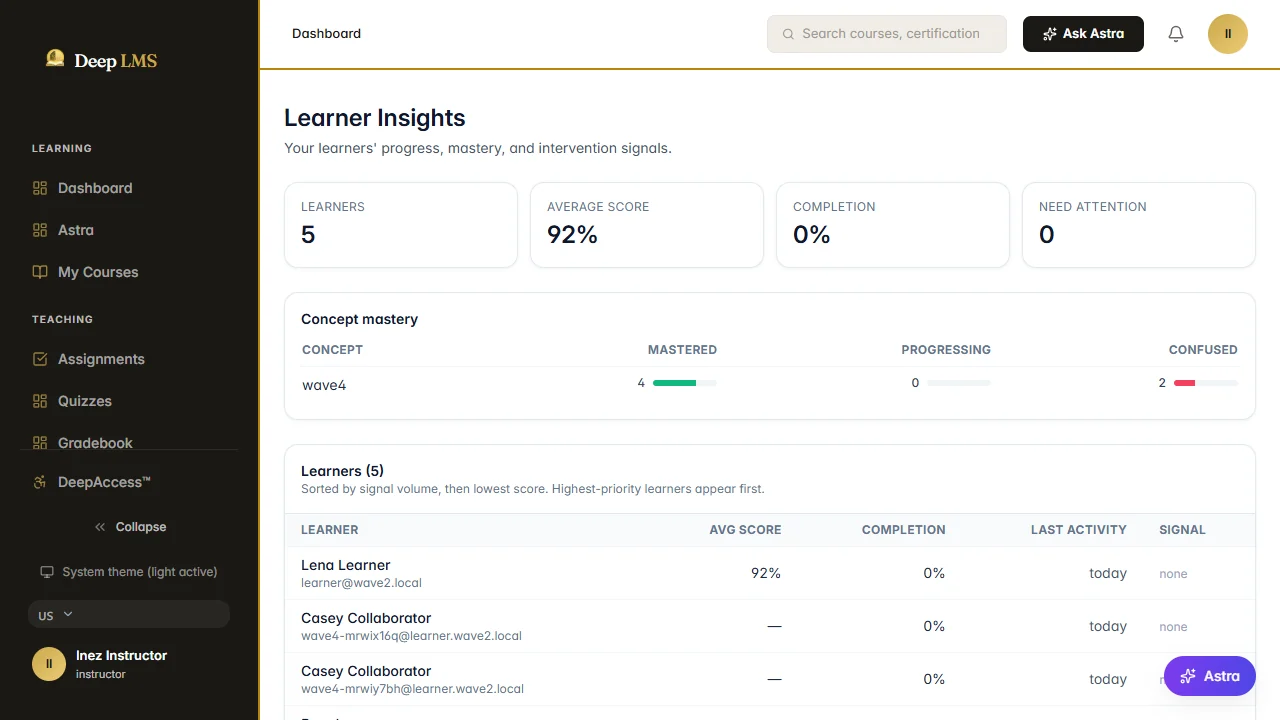
Start with the question, not the dashboard
A manager checking overdue training needs different evidence from an instructor improving a difficult lesson. Decide which decision the report should support before selecting a chart. Otherwise, the easiest number to display can become an accidental definition of success.
Jisc's learning analytics code stresses validity, incomplete data, and interpretation alongside other information. Its education-sector guidance is a useful reference for reading learning signals carefully, not a legal standard for every workplace. Jisc: Code of practice for learning analytics, validity and interpretation.
Keep the meaning of each signal narrow
| Report signal | Reasonable reading | Do not assume |
|---|---|---|
| Completed activity | The recorded completion condition was met. | The person can perform the task independently. |
| Assessment score | Performance on that assessment under its conditions. | A complete measure of practical capability. |
| Low recorded activity | Few events were captured in the measured channel. | Lack of effort, motivation, or learning elsewhere. |
Ask what the report leaves out
- Check the definition: what event counts as a completion, attempt, or active session?
- Check the coverage: are offline activities, accommodations, or external learning absent?
- Check comparability: did learners receive the same task, preparation, and assessment conditions?
- Check the next evidence: would a conversation, work sample, or supported practice clarify the result?
- Limit access and use: share only the learner information needed for the stated purpose.
Use the result to improve support
Hypothetical example: a team completes a course but struggles with a workplace procedure. The completion report answers an administrative question. A relevant practice task, reviewed against clear criteria, answers a different question about application. Neither should be presented as the other's substitute.
CDC training guidance distinguishes learning from transfer to the workplace and recommends follow-up evaluation when appropriate. This is general training guidance from a public-health context, not evidence about a particular learning platform. CDC: Evaluate Training - Measuring Effectiveness.
A useful reporting conversation ends with a bounded next step: clarify an ambiguous assessment, improve a lesson, offer practice, or investigate a data gap. Avoid using a single score to label a person when the available evidence supports only a narrower conclusion.
References & further reading
Company editorial prepared with AI assistance. Sources and technical checks do not constitute independent expert review.